Why Building Health Matters
The materials we choose to build with directly impact the health of those living inside. Many conventional building products off-gas harmful chemicals, including volatile organic compounds (VOCs), formaldehyde, and flame retardants that have been linked to respiratory issues, allergies, and long-term health effects.
Earth Bound Homes prioritizes healthy building practices by selecting non-toxic materials, avoiding known harmful chemicals, and using proven remediation techniques. We believe that a healthy home is a happy home—and it starts with what you build it from.
Screening For Toxic Chemicals
The EPA estimates Americans spend roughly 90% of their time indoors, where concentrations of some pollutants can be 2–5 times higher than outdoors. Many building products still contain chemicals classified by IARC, the NTP, or the EPA as known or probable carcinogens, endocrine disruptors, or respiratory sensitizers — and they don't have to disclose them on the label. These screening tools let you look up any material by its CAS number or product name and check it against peer-reviewed hazard databases before it goes into your walls, your floors, or the air your kids breathe.
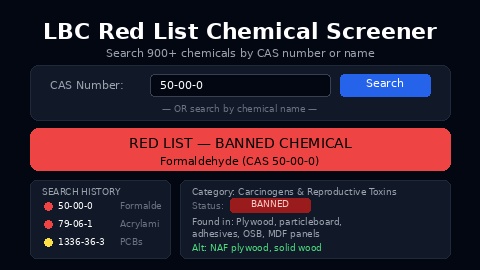
LBC Red List Chemical Screener
Search 900+ chemicals by CAS number or name to check against the Living Building Challenge Red List of banned and restricted substances.
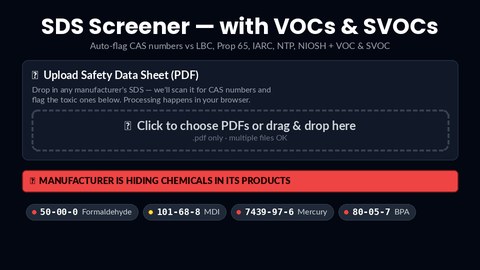
SDS Toxic Chemical Screener
Upload any manufacturer’s Safety Data Sheet (SDS) PDF and auto-flag every CAS number against the LBC Red List, California Prop 65, IARC, NTP RoC, NIOSH, and GSPI Six Classes — plus VOC & SVOC classification. Screened products are saved to the community Material Health database below.
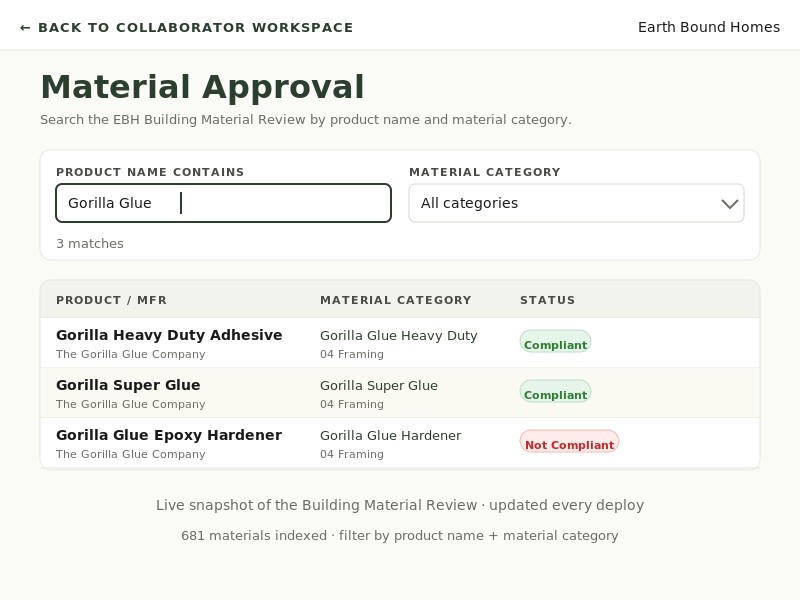
Material Health Database — Community Submissions
Browse every product screened with the public SDS screener: full chemical breakdowns, hazard-database verdicts, and the attached SDS documents.
Why You Should Never Use Spray Foam
Closed-cell spray polyurethane foam (ccSPF) is manufactured on-site by mixing methylene diphenyl diisocyanate (MDI) with a polyol blend containing amine catalysts, organophosphate flame retardants (typically TCPP), and blowing agents. Even in a textbook-perfect installation, the cured foam continues to release residual MDI, triethylamine, and TCPP into indoor air for months to years. OSHA's permissible ceiling for MDI is just 0.02 ppm — a threshold that peer-reviewed field studies have shown is regularly exceeded in occupied homes with spray foam. NIOSH Technical Note 1921 documents cases of persistent respiratory sensitization, vision disturbance, and neurological symptoms in occupants. Once sensitization occurs, there is no known safe re-exposure level. These guides walk through the documented failure modes, the chemistry behind them, and evidence-based remediation options if spray foam is already in your home.
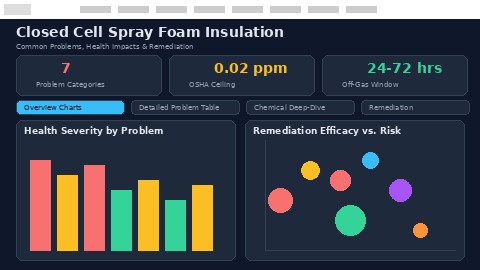
Spray Foam Problems, Health Impacts & Remediation
A detailed exploration of spray foam insulation issues, the health impacts of off-gassing chemicals, and proven remediation solutions.
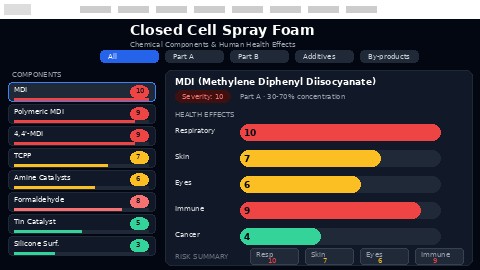
Spray Foam Health Effects Explorer
Interactive guide examining specific health effects linked to spray foam chemicals and off-gassing compounds.
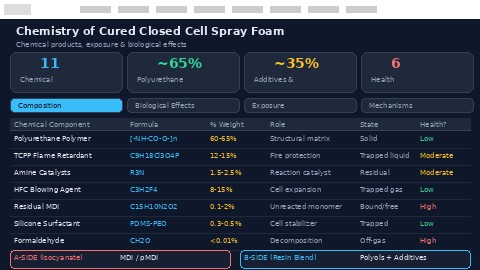
Chemistry of Cured Closed Cell Spray Foam
Technical deep-dive into the chemical composition of spray foam and how curing processes affect chemical stability.
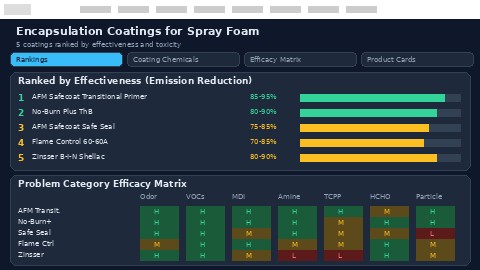
Encapsulation Coatings — Product Comparison
Compare different encapsulation coating options for containing off-gassing chemicals and mitigating health risks.
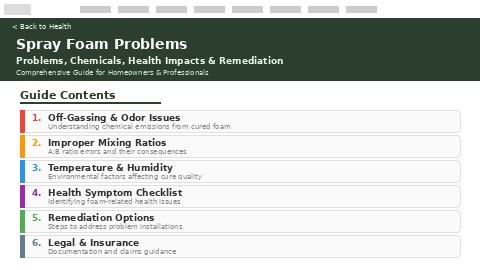
Spray Foam Problems Guide
Complete reference guide covering spray foam installation issues, common problems, and troubleshooting approaches.
EMFs — How To Stay Safe
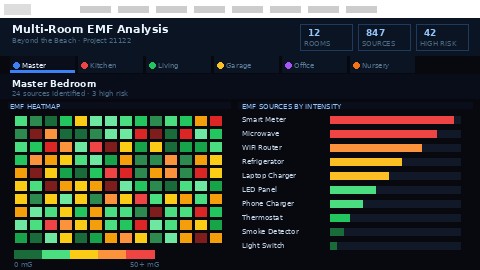
The scientific community has not reached consensus on whether chronic low-level electromagnetic field exposure causes harm — the WHO's International Agency for Research on Cancer classifies ELF magnetic fields as "possibly carcinogenic" (Group 2B), and the BioInitiative Working Group has published over 1,800 studies suggesting biological effects below current ICNIRP guidelines. We don't think families should have to wait decades for regulatory bodies to catch up. The precautionary principle — the same framework the EU applies to chemical regulation — says that when credible evidence of potential harm exists and the cost of precaution is low, you act. Shielding wiring, choosing low-EMF appliances, and keeping sleeping areas away from panels and smart meters are simple, inexpensive steps. This tool helps you map EMF levels room by room so you can make informed decisions for your family.
Toxic Chemicals — How They Make Us Sick
Children are not small adults. Pound for pound, they breathe more air, drink more water, and eat more food than adults do — and their developing organs, nervous systems, and hormonal pathways are far more vulnerable to chemical disruption. A 2023 study in Environmental Health Perspectives found that children in homes with higher concentrations of semi-volatile organic compounds (SVOCs) had measurably altered thyroid hormone levels. The chemicals below are among the most common in residential construction. Each card summarizes what the chemical is, where it hides, what the peer-reviewed literature says about its health effects, and what safer alternatives exist. For chemicals where we've built interactive deep-dives — with exposure limits, molecular mechanisms, and remediation data — there's a link to the full guide.
Formaldehyde
IARC Group 1 CarcinogenIsocyanates (Residual MDI)
Respiratory SensitizerFlame Retardants (TCPP/PBDE)
Endocrine DisruptorAmine Catalysts (TEA/DMCHA)
Corneal ToxicantVOCs (Volatile Organic Compounds)
NeurotoxicantPhthalates
Endocrine DisruptorLead
NeurotoxicantHealthy Building Alternatives
Choosing the right materials makes all the difference. Here are recommended healthy alternatives by building category.
Insulation
- Mineral wool / Rock wool
- Fiberglass (unfaced)
- Cellulose (recycled paper)
- Cork insulation
- Wood fiber boards
- Sheep's wool
Paints & Finishes
- Zero-VOC paints
- Low-VOC primers
- Water-based stains
- Natural oils & waxes
- Milk paint
- Plant-based sealers
Flooring
- Solid hardwood
- Cork flooring
- Natural linoleum
- Ceramic/porcelain tile
- Bamboo flooring
- Natural rubber
Adhesives & Sealants
- Low-VOC adhesives
- Water-based sealants
- Natural rubber-based products
- Formaldehyde-free wood glues
- Plant-based adhesives
- Silicone sealants
Healthy Homes & Indoor Air Quality
Watch our comprehensive video series on building healthy homes, understanding indoor air quality, and choosing non-toxic materials.