A new single-family home, designed and built to certified Passive House performance — using roughly 90% less energy than a code-built California home, with continuously filtered fresh air, a near-airtight envelope, and a non-combustible exterior engineered for the wildland-urban interface.
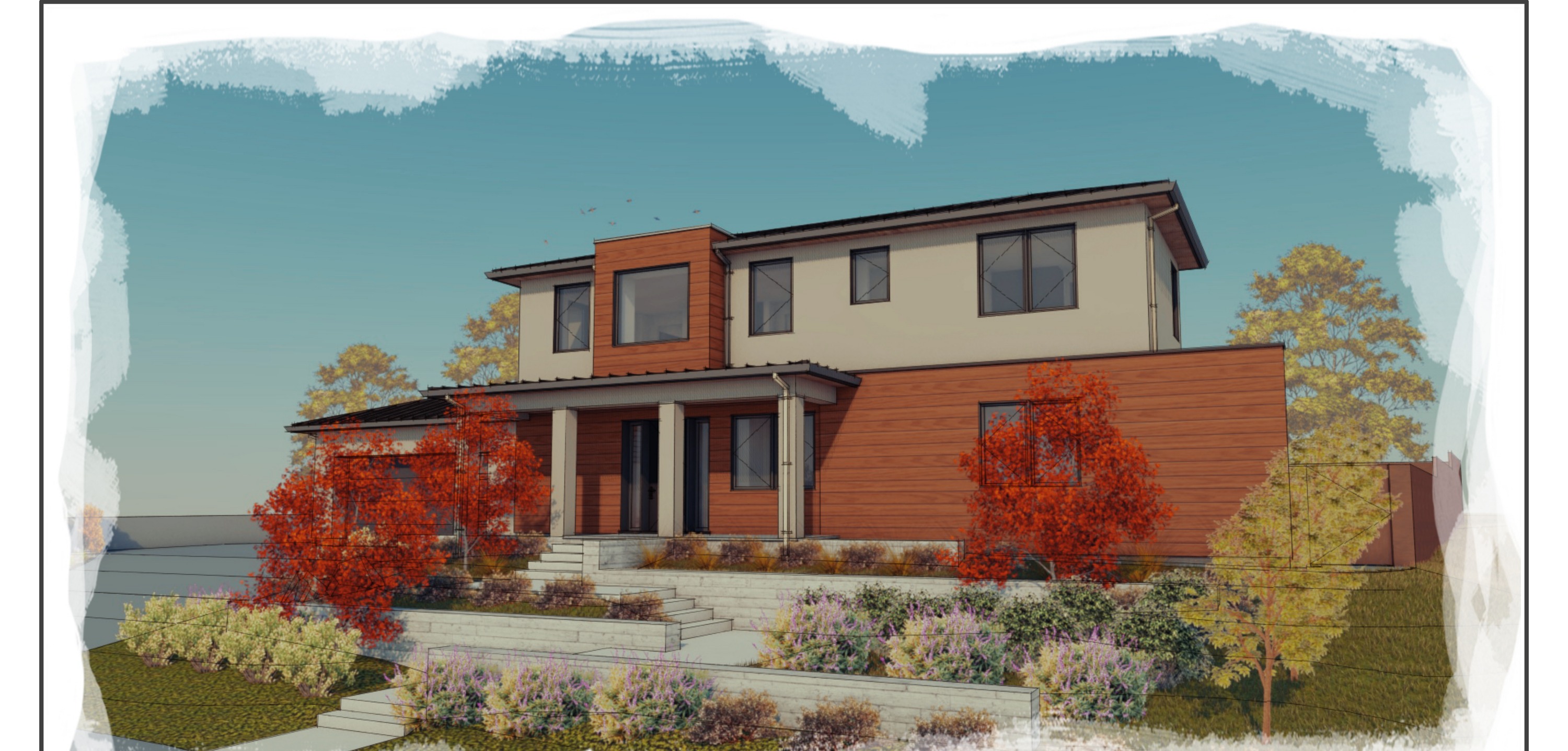
Continuous insulation, an airtight shell, and triple-pane windows mean almost no heat escapes. The whole home stays warm with a fraction of the energy a typical house needs.
A typical winter's heating runs on roughly 1/10th the energy of a code-built home.
Heat doesn't escape because there's almost nowhere for it to go. The home is built like a thermos: continuous insulation outside the structure, with no thermal bridges through framing, no leaky penetrations, and high-performance triple-pane glazing.
The mean envelope U-value works out to 0.156 W/m²K — roughly R-36 across the whole shell, vs. ≈ R-19 effective in a typical code-built California wall.
| Assembly (mean U) | U-value | ≈ R |
|---|---|---|
| Whole envelope (above grade) | 0.156 W/m²K | R-36 |
| Slab on grade (to ground) | 0.128 W/m²K | R-44 |
| Wall assembly (continuous + cavity) | ~0.105 | R-54 |
| Roof assembly | ~0.090 | R-62 |
| Windows installed (Uw) | 0.90 W/m²K | ≈ U-0.16 |
Most homes have hundreds of small gaps in their walls and ceilings. Each is a path for drafts, energy loss, and — in California — wildfire smoke. This shell is sealed, taped, and pressure-tested.
About 10× tighter than the same house built to current code.
Every joint, every penetration is sealed against air movement. A vapor-permeable air-barrier membrane wraps the structure on the outside; tapes and gaskets close every seam; cans, ducts, and electrical penetrations get airtight sealing kits.
It isn't taken on faith — the house is pressurized to 50 pascals with a blower door, and any leak above target is hunted down and fixed before drywall closes the wall.
| Detail | Spec |
|---|---|
| Primary air barrier | Vapor-permeable WRB, taped & sealed |
| Window/door rough openings | Liquid-applied flashing + tape |
| Penetrations | Airtight gaskets & sealants |
| Test method | Blower door @ 50 Pa |
| Target leakage rate (n50) | ≤ 0.6 ACH₅₀ |
| Code-built baseline (CA) | ~ 3 ACH₅₀ |
| Older homes (typical) | 5–10 ACH₅₀ |
An airtight house breathes through one place: a continuously running, filtered heat-recovery ventilator. Pollen, traffic soot, and wildfire smoke get filtered out before they reach a bedroom.
During wildfire season, most smoke enters homes through the same cracks that leak heat: sill plates, recessed lights, attic penetrations. Sealing the envelope means sealing out smoke.
Combined with a filtered HRV that gently pressurizes the interior with clean outdoor air, the family inside has a refuge of breathable air — even when the sky is orange.
Outdoor air is filtered to MERV-13 — pollen, traffic soot, and wildfire PM 2.5 are removed before air ever reaches a bedroom.
The HRV captures roughly 69% of the heat in the leaving air, so fresh air doesn't mean cold air or a big bill. The result is a quieter, low-CO₂, low-allergen version of the world outside.
The HRV runs continuously at a low rate, replacing roughly the entire air volume of the home every 2–3 hours with filtered fresh air — quietly, efficiently, and balanced.
Stale air from kitchens and baths leaves through one duct; fresh outdoor air enters through another, passing through the filter and the heat exchanger on the way to bedrooms and living spaces.
| Parameter | Spec |
|---|---|
| Effective heat recovery efficiency (PHPP) | 69% |
| Humidity recovery efficiency | 64% |
| Supply filtration | MERV-13 |
| Operation | Continuous, balanced, low-power |
| Supply locations | Bedrooms · living areas · office |
| Return locations | Kitchen · bathrooms · laundry |
| Auxiliary | No range hood recirculation; sealed make-up air |
Triple-pane windows with two argon-filled cavities aren't only thermal insulators — they're sound insulators. Street traffic, neighbours, the lawnmower next door: all quieter from the inside.
Each ~10 dB drop sounds about half as loud to the human ear.
The same triple-pane glazing that drives down heat loss is also a heavy, dense barrier to airborne sound. Each cavity de-tunes a different frequency band; argon damps mid-range traffic; the laminated outer pane handles high-frequency noise.
Frames are insulated and thermally broken — not aluminum, not vinyl — so they don't become a path for either heat or noise around the glazing.
| Spec | Value |
|---|---|
| Glazing makeup | Triple-pane, two argon cavities, low-E coatings |
| Window U-value installed (Uw) | 0.90 W/m²K (≈ U-0.16) |
| Solar heat gain (g-value / SHGC) | 0.52 |
| Frame | Insulated, thermally broken |
| Window area | 68.3 m² · 735 sf |
| Window-to-wall ratio | 23.3% |
| Estimated outside-noise reduction (OITC) | ~38–42 dB |
Because the envelope is so efficient, the entire home — heat, cooling, hot water, induction cooking, EV charging — runs on a modest rooftop solar array. The grid acts as a battery: surplus power flows out in summer, and comes back in winter.
Annual solar generation is sized to match annual whole-house electricity demand. With Passive House construction cutting heating/cooling loads 80–90%, the panels needed are roof-friendly, not roof-covering.
All-electric end-uses: heat-pump heating & cooling, heat-pump water heating, induction cooking, EV charging — no gas line, no combustion in the home.
Because Passive House construction collapses heating and cooling demand by ~80–90%, the residual electricity load is mostly water heating, plug loads, lighting, induction cooking, and EV charging. A right-sized rooftop array balances that annual load.
Operating cost: essentially the cost of being grid-connected, after accounting for net-energy metering. No gas line, no combustion appliances, no CO from cooking.
| Energy use | Approach |
|---|---|
| Heating & cooling | Air-source heat pump · all-electric |
| Domestic hot water | Heat-pump water heater |
| Cooking | Induction (no gas service) |
| EV charging | Level 2 — wired in |
| Backup | All-electric · no combustion in the home |
| Generation | Roof PV — sized for net-zero annual electricity |
| Net annual energy | ≈ 0 kWh / year |
Wildfires destroy homes mostly through wind-blown embers finding flammable surfaces and unsealed openings. This exterior is built almost entirely from non-combustible materials.
Combined with the airtight envelope, the result is a home that resists ignition outside and keeps smoke outside.
The roof is the primary ember target. So it's standing-seam metal — the highest fire rating available (ASTM E108 Class A) — with sealed edges and ember-resistant attic vents.
The walls are stucco and fiber-cement, with mineral wool in critical layers. There's no exposed wood at the ember-vulnerable details: eaves, rake edges, soffits, and decks are detailed for ignition resistance.
| Element | Spec |
|---|---|
| Roof | Standing-seam metal · Class A (ASTM E108) |
| Cladding | Stucco + fiber-cement, ASTM E84 Class A |
| Insulation in fire-critical zones | Mineral wool (non-combustible) |
| Attic / soffit vents | Ember-resistant 1/16" mesh |
| Eave details | Sealed, no exposed framing |
| Decking | Composite or non-combustible substrate |
| Combustible materials at perimeter | Minimized · no wood within 5 ft of structure |
Independent third-party energy modeling using PHPP v10.6 (Passive House Planning Package).
| Treated floor area (TFA) | 311.98 m² · 3,358 sf |
| Annual heating demand | 5.0 kWh/m²·yr (PH limit ≤ 15) |
| Annual cooling + dehumidification | 11.1 kWh/m²·yr (PH limit ≤ 15) |
| Heating load | 6.7 W/m² (PH limit ≤ 10) |
| Airtightness · n50 | ≤ 0.6 ACH₅₀ (target) |
| Non-renewable primary energy (PE) | 58 kWh/m²·yr (PH limit ≤ 120) |
| Frequency of overheating (>25 °C) | — (none predicted) |
| Mean envelope U-value | 0.156 W/m²K · ≈R-36 |
| Slab / ground U-value | 0.128 W/m²K · ≈R-44 |
| Window U-value, installed (Uw) | 0.90 W/m²K · ≈ U-0.16 |
| Glazing solar heat gain (g-value) | 0.52 |
| Window area / wall ratio | 68.3 m² · 23.3% of exterior wall |
| Cladding | Stucco, fiber-cement, vertical wood accent |
| Roof | Standing-seam metal · Class A |
| Ventilation | HRV · 69% effective heat recovery · MERV-13 |
| Heating & cooling | Air-source heat pump · all-electric |
| Domestic hot water | Heat-pump water heater |
| Cooking | Induction · no gas service |
| Solar PV | Roof-mounted · sized for net-zero annual electricity |
Independent third-party energy modeling (PHPP v10.6) plus the construction details that produce these numbers. For the spec-curious.
| Parameter | Value | Unit / Note |
|---|---|---|
| Treated Floor Area (TFA) | 311.98 | m² · 3,358 sf |
| Equivalent occupants | 3.2 | persons (PHPP standard) |
| Climate zone | Warm / CZ3 | California coastal |
| Heating-season avg outdoor temp | 10.8 | °C |
| Cooling-season avg outdoor temp | 20.5 | °C |
| Construction year | 2026 | Type V-B · R-3 single-family |
| Climate dataset | PHPP US-coastal | Altitude corrected |
| Criterion | PH limit | This house | vs. limit | Pass |
|---|---|---|---|---|
| Annual heating demand | ≤ 15 kWh/m²·a | 5.0 | 67% below | ✓ Yes |
| Heating load | ≤ 10 W/m² | 6.7 | 33% below | ✓ Yes |
| Cooling + dehumidification demand | ≤ 15 kWh/m²·a | 11.1 | 26% below | ✓ Yes |
| Airtightness · n50 @ 50 Pa | ≤ 0.6 ACH₅₀ | ≤ 0.6 | Meets target | ✓ Target |
| Frequency of overheating > 25 °C | ≤ 10% | 3.2% | Well below | ✓ Yes |
| Frequency of excess humidity > 12 g/kg | ≤ 10% | 0% | No occurrences | ✓ Yes |
| Primary energy non-renewable (PE) | ≤ 120 kWh/m²·a | 58 | 52% below | ✓ Yes |
| Layer (outside → inside) | Material | Thickness | ≈ R-value |
|---|---|---|---|
| Cladding | Stucco · fiber-cement panel · vertical wood accent | ¾" | R-1 |
| Drainage / vent cavity | Open rainscreen, drained | ½" | R-1 |
| Continuous exterior insulation | EPS / mineral-wool board, taped | 6½" | R-27 |
| Air / weather barrier | Vapor-permeable WRB, taped seams | — | — |
| Sheathing | Plywood, taped (joins air barrier system) | ⅝" | R-1 |
| Structural wall | 2x6 wood studs @ 16" o.c. | 5½" | R-6 |
| Cavity insulation | Mineral-wool batts (non-combustible) | 5½" | R-18 |
| Interior finish | Gypsum wallboard + paint | ⅝" | R-1 |
| Wall assembly total | Continuous + cavity insulation | ~14" | ≈ R-54 |
| Layer (outside → inside) | Material | Thickness | ≈ R-value |
|---|---|---|---|
| Roofing | Standing-seam metal · Class A (ASTM E108) | — | R-0 |
| Underlayment | High-temp self-adhered membrane | — | R-0 |
| Continuous insulation | Polyiso foam, staggered seams | 8½" | R-49 |
| Sheathing / air barrier | Plywood + taped seams | ¾" | R-1 |
| Truss / rafter zone | Vented attic, cavity unconditioned | — | — |
| Ceiling finish | Gypsum + paint | ⅝" | R-1 |
| Roof assembly total | Continuous over deck | ~10" | ≈ R-51 minimum |
| Layer | Material | Thickness | ≈ R-value |
|---|---|---|---|
| Slab | Concrete | 4" | R-0 |
| Sub-slab continuous insulation | XPS foam (closed-cell) | 4–6" | R-20 → R-30 |
| Vapor barrier | Reinforced poly, taped to walls | — | — |
| Capillary break / drainage | Compacted gravel | 4" | — |
| Slab to ground (mean U) | Continuous | — | U-0.128 W/m²K · ≈ R-44 |
| Spec | Value | Notes |
|---|---|---|
| Glazing makeup | Triple-pane | Two argon-filled cavities, low-E coatings |
| Window U-value installed (Uw) | 0.90 W/m²K | ≈ U-0.16 in U.S. units |
| Glazing solar heat gain (g-value / SHGC) | 0.52 | Tuned for winter solar capture |
| Frame | Insulated, thermally broken | Not aluminum, not vinyl |
| Total glazing area | 68.3 m² · 735 sf | 23.3% of exterior wall area |
| Estimated outside-noise reduction (OITC) | ~38–42 dB | vs. ~28 dB code dual-pane |
| System | Spec |
|---|---|
| Heating & cooling | Air-source heat pump (variable speed) |
| Domestic hot water | Heat-pump water heater (HPWH) |
| Ventilation | Heat-recovery ventilator (HRV) |
| Heat-recovery efficiency (effective) | 69% |
| Humidity-recovery efficiency | 64% |
| Filtration | MERV-13 supply |
| Cooking | Induction |
| EV charging | Level 2, hardwired |
| Solar PV | Roof-mounted · sized for net-zero annual electricity |
| Combustion appliances | None — all-electric, no gas service |
General contractor & Passive House builder.
Building the next generation of high-performance homes in the Bay Area.
Architecture & design.
Campbell, CA · ncfarchitect.com